
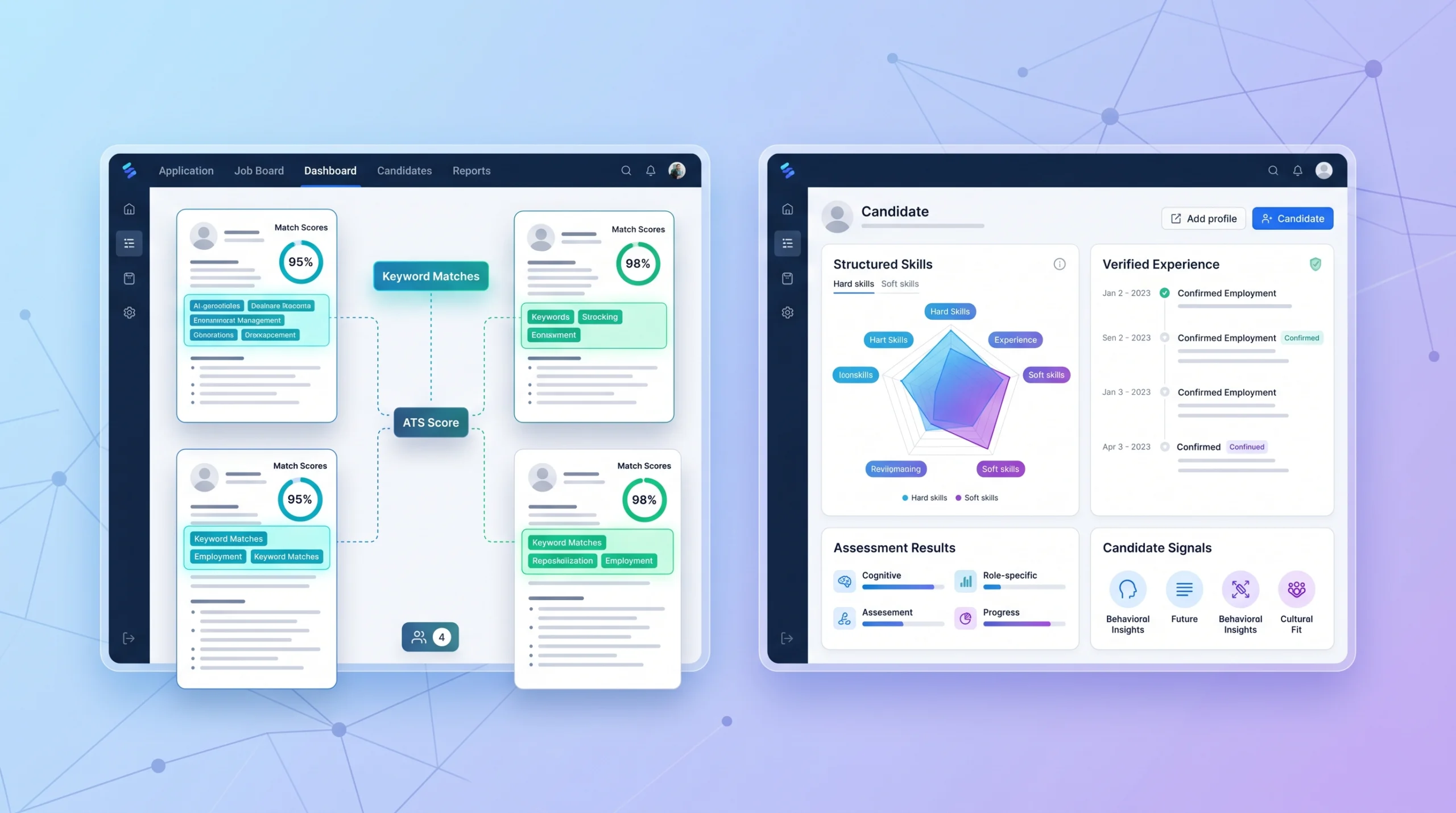
A high resume ATS score no longer signals a strong candidate. Generative AI tools now write resumes that hit every keyword an applicant tracking system checks for, so almost every applicant scores well. Traditional screening built on keyword matching cannot tell a genuinely qualified candidate from a well-prompted AI resume. The fix is not a stricter score cutoff. It is moving from score-based filtering to structured, skills-based signals that AI cannot fake as easily.
Open a stack of resumes for almost any role today, and something strange happens: they all read the same. Same action verbs, same “cross-functional collaboration,” same suspiciously polished bullet points. That is not a coincidence, and it is not a sign your applicant pool suddenly got better. It is generative AI, quietly rewriting every resume to hit the exact keywords your applicant tracking system is scanning for.
The result is a resume ATS score that used to separate strong candidates from weak ones, and now barely separates anyone. If four out of five applicants can generate a resume that scores ninety or above, the score has stopped doing its job. Here is why that is happening, what it means for how you screen, and what still actually works.
Why Every Applicant Suddenly Looks Equally Qualified
Recruiters are spending hours screening resumes that all sound equally strong because generative AI has learned to write toward whatever your applicant tracking system rewards. It does not matter if a candidate has two years of experience or ten. The AI can phrase either resume so it lands a near-identical ATS score.
This is not a fluke caused by a handful of overachieving job seekers. It is the default behavior of nearly every free AI resume tool on the market. Feed it a job description, and it rewrites the resume to mirror that language back, almost sentence for sentence.
For a recruiter, that means the first filter you relied on, the score, no longer tells you who is worth an interview. It only tells you who used AI, and right now, that is nearly everyone.
Why Traditional Screening Was Built for a World That No Longer Exists
Traditional keyword-and-score screening assumed a resume reflected genuine effort and self-selection: only a reasonably qualified, motivated candidate would bother tailoring a resume that closely to a job posting. Most AI recruiting software still runs on that assumption, checking for exact keyword overlap through the same logic older applicant tracking system ATS software has used for years. That assumption no longer holds.
Here is what those signals used to mean, before AI resume writing became universal:
- A resume closely matching the job posting’s language used to mean the candidate had read it carefully.
- Varied, specific phrasing across a work history used to mean real, distinct experience.
- A high keyword match score used to mean strong overlap with the role’s actual requirements.
None of those signals hold up anymore. Any candidate with access to a free AI CV creator or resume builder can hit all three without doing the work those signals were supposed to represent. This is not a case of one group of candidates gaming the system while others play fair. It is used across the board, which is exactly why it stops helping anyone screen.
What a High Resume ATS Score Actually Tells You Now
A high resume ATS score today mostly tells you a candidate used an AI resume builder well, not that they are the best fit for the role. That is a meaningful shift, and it changes what the score is actually good for.
It has not become useless. It has become narrower:
- Still useful for filtering out candidates genuinely off-track for the role, such as the wrong industry or missing hard requirements.
- Still useful as a first-pass check when application volume is high, and you need any signal at all.
- No longer useful for ranking “strong” against “average” candidates within the pool that clears the bar.
- No longer useful for predicting who will actually perform well once hired.
What Good Screening Looks Like in Practice
Good screening now leans on structured, skills-based signal, such as verified experience details, work samples, and specific project outcomes, instead of relying on the score a resume produces against a job description. Many recruiting teams are re-examining their AI recruitment platform and asking whether it can separate real signal from AI-polished noise at all.
A few adjustments make the biggest difference:
- Move keyword matching from a pass-or-fail gate to one input among several, not the deciding one.
- Ask for specific, checkable details in the application, like a metric, a tool, or a project outcome, that a generic AI rewrite cannot invent convincingly.
- Weight structured screening questions and skills assessments higher than resume score alone.
- Track how resume score correlates with later-stage performance for your own roles, and recalibrate every quarter as AI writing tools keep improving.
Where Xorofy Fits Into the Fix
Xorofy’s screening pipeline is built around structured signals rather than a single resume score, so a well-written AI resume does not automatically outrank a candidate with real, verifiable experience based on resume ATS score alone.
Instead of centering the process on one keyword-matched number, Xorofy separates screening into stages that pull in the details keyword matching misses, including verified skills fields, structured intake responses, and stage-specific notes recruiters can compare side by side. It works as AI recruiting software without asking recruiters to hand the decision to a single AI-generated score.
For teams evaluating an AI recruitment platform built for exactly this shift, the goal is not to out-AI the resume writers. It is to give recruiters a screening process where an inflated score does not quietly decide who gets an interview, which is a meaningfully different job than most applicant tracking system ATS software was originally designed to do.
The Bottom Line: Score the Signal, Not the Resume
The takeaway is not complicated. A resume ATS score measures how well a resume was written toward your job posting, not how well a candidate will do the job. Generative AI has closed the gap between “wrote a great resume” and “is a great candidate” almost completely, and no scoring adjustment fixes that on its own.
What holds up is structured, verifiable signal, the kind that is harder to generate convincingly than a paragraph of keyword-matched prose. Build your screening process around that, and the score becomes one input again, not the whole decision.