
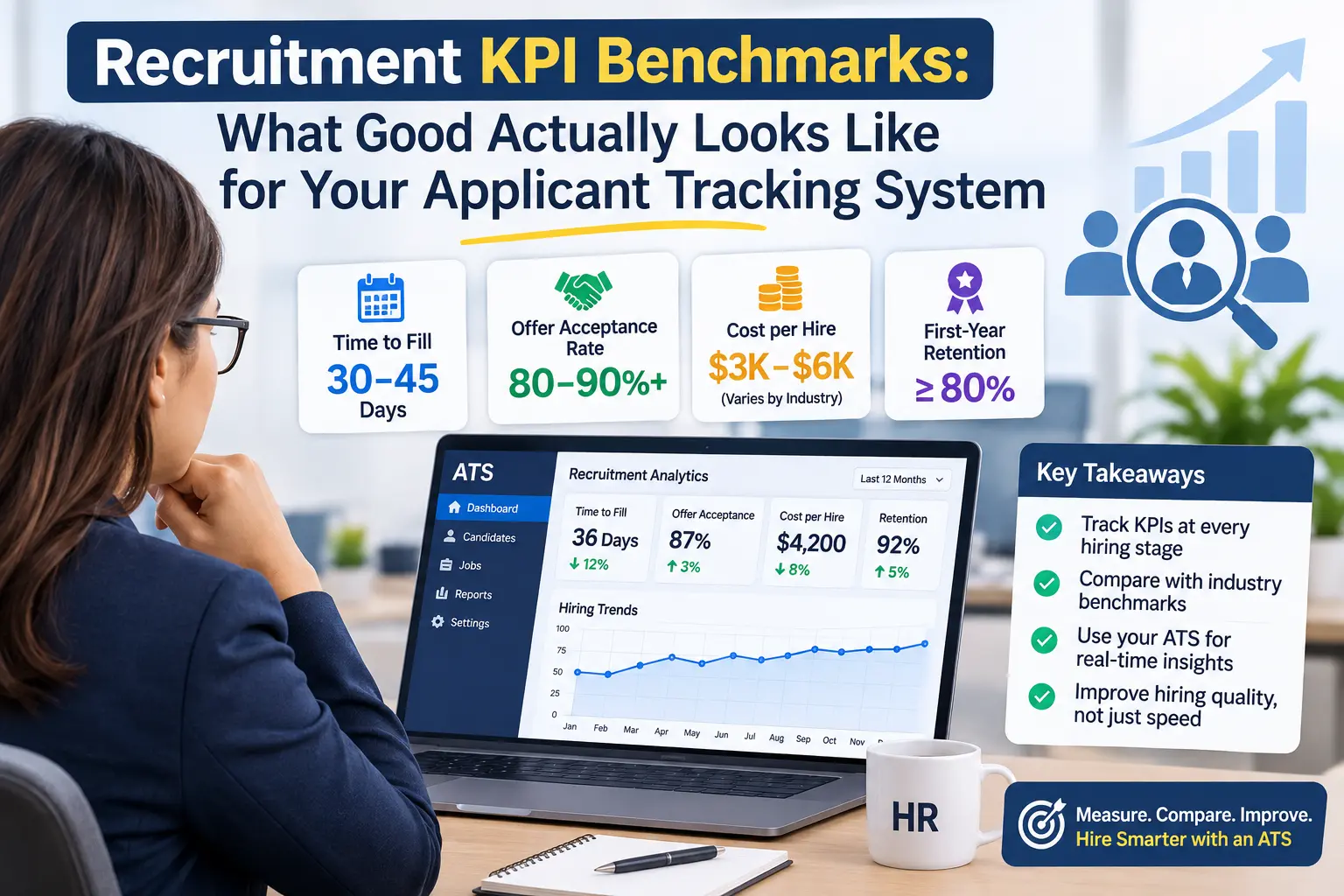
An applicant tracking system helps HR teams measure recruitment KPIs against realistic benchmarks. Common targets include 30 to 45 days to fill, an 80 to 90 percent offer acceptance rate, steady cost per hire, and strong first-year retention. Ranges vary by industry and role, so use them as a starting point. Track each metric by hiring stage and compare it with your own history.
Your CEO asks a simple question: are we hiring well? You open a report, and the numbers seem fine. But fine compared to what? Without a clear standard, even strong data tells you very little. A modern applicant tracking system can show you every hiring number you need. The harder part is knowing which numbers are good.
This guide shows what good looks like for the metrics HR leaders watch most. You will see practical ranges, learn what moves each number, and find out how to build a reliable baseline. Treat the ranges as starting points. Your industry, role mix, and hiring volume will shift them. The goal is not to copy a benchmark. The goal is to know where you stand and where to improve next.
Time to Fill: The Clock Hiring Managers Feel First
Most roles should close in 30 to 45 days. Senior and technical roles often take longer. If your average runs well past your own role history, you have a bottleneck, not a talent shortage.
Delays usually hide in handoffs. A resume waits for review, an interview waits for a calendar slot, and an offer waits for approval. Track each stage on its own to find the slow one. Good applicant tracking software shows these gaps without extra effort.
Cost per Hire: Spend Wisely, Not Just Less
A healthy cost per hire stays steady while quality holds. Ranges differ by market and seniority, so compare against your own past quarters before looking outside.
Count every cost, not only job ads. Many teams understate the figure by skipping internal hours. Include:
- Job board and advertising fees
- Agency charges
- Recruiter and hiring manager time
- Assessment tools and applicant tracking system software
Offer Acceptance Rate: Your Candidates’ Honest Report Card
A good offer acceptance rate sits between 80 and 90 percent or higher. A lower number tells you candidates are unhappy with pay, speed, or communication.
Fix the cause, not the symptom. Slow offers lose strong candidates to faster employers. Unclear pay ranges cause late rejections. Your applicant tracking system can flag stalled offers so that you can step in early. Regular updates during the process also keep people engaged.
Quality of Hire: Proof That Speed Did Not Cost You
Quality of hire shows whether new employees perform well and stay. Strong first-year retention and positive manager ratings are the clearest signs of healthy hiring.
Link performance reviews to the source of each hire. You will learn which channels bring people who stay and which ones only bring volume. An ATS applicant tracking system can connect these records, so you stop guessing and start comparing. That insight lets you move budget toward the channels that work.
From Scattered Spreadsheets to Numbers You Can Trust
You cannot benchmark what you cannot measure, and spreadsheets rarely measure hiring well. Missing dates and mismatched stage names make every figure doubtful.
Reliable applicant tracking software records each step automatically. That gives leaders clean data for recruitment tracking and fair comparisons over time.
What Your Applicant Tracking System Should Report
A strong ATS should show time in each stage, source of hire, and drop-off points without manual work. Look for:
- Stage-by-stage hiring speed
- Source quality, not just volume
- Offer and acceptance trends
Xorofy’s applicant tracking system gives HR teams these views in one place. Managers can make faster staffing decisions because hiring data is current. Pair it with HR analytics to see how hiring connects to retention.
FAQs
What is a good time to fill?
Most roles close in 30 to 45 days. Compare by role level, since senior hires take longer.
Do I need an applicant tracking system to track benchmarks?
Not strictly, but manual tracking invites errors. Applicant tracking system software timestamps every stage and builds trend reports.
Benchmarks Point the Way. Your Data Proves the Progress.
The best use of an applicant tracking system is simple: measure honestly, compare with your own history, and fix one bottleneck at a time. Benchmarks give you direction. Consistent tracking gives you proof.