
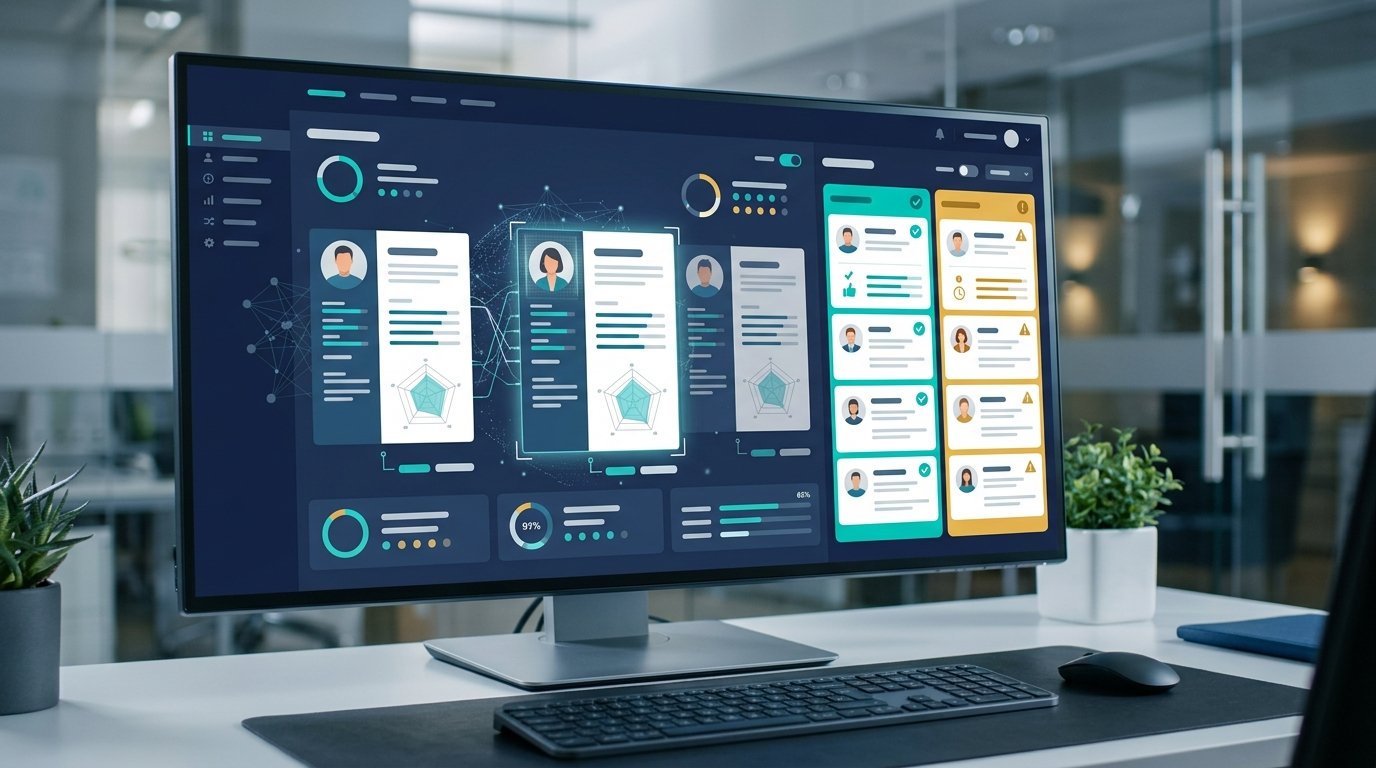
AI-assisted CV screening works best when it quickly filters obvious mismatches, then hands borderline profiles to a recruiter for the final call. On its own, an algorithm can miscategorize strong candidates who used a different resume format or a less common job title. Paired with human review at the flagged stage, screening tools speed up the funnel without losing qualified people. The goal isn’t full automation. It’s automation that knows where to stop.
A recruiter opens an AI-generated shortlist and immediately spots the problem: two strong candidates are missing, and three weak ones made the cut. This happens more often than most hiring teams admit, and it’s why so many recruiters quietly go back to reading every resume by hand. CV screening software promises speed. What it doesn’t always deliver is judgment.
The truth sits somewhere between “AI screening is useless” and “AI screening solves everything.” Some parts of resume screening are genuinely mechanical and safe to automate. Others still need a person who understands context. Knowing which is which, and building a process around that line, is what separates hiring teams who trust their tools from those who quietly ignore them.
When AI Screening Flags the Wrong Candidates First
AI screening earns distrust the moment it rejects someone a recruiter would have hired, or forwards a resume that clearly doesn’t fit. It usually happens for a narrow set of reasons: unconventional formatting, an unusual job title, or a resume that lists the right skills without the exact keyword the tool was trained to match. None of these things predict whether someone can actually do the job.
A candidate who spent five years as a “Talent Partner” instead of “Recruiter” can fall out of a keyword-based filter, even with the right experience. A strong CV screening system should catch that. Many still don’t, because they were built to match text, not to understand a career.
That’s the real source of the trust problem. It isn’t that automation is wrong for hiring. It’s that too many tools skip the step where a person confirms the machine’s first pass before anyone gets ruled out.
Where Algorithms Help and Where Human Judgment Still Wins
Algorithms are reliable at narrowing volume. They’re far less reliable at judging fit. A tool built for resume scanning can sort five hundred applications into a shortlist of fifty within minutes, catching obvious mismatches on location, experience level, or required certifications. That part of resume screening rarely needs a second opinion.
What still needs a person: reading between the lines on a career change, weighing relevant experience that doesn’t map neatly onto a job title, or noticing potential in someone slightly underqualified on paper but strong everywhere else. These are judgment calls, not pattern matches. No resume scanning tool, however advanced, replaces that yet.
Powerful screening tools are built around this split. They handle the volume problem honestly, then step back and let a recruiter make the calls that actually require thinking.
Building a CV Screening Process That Actually Earns Trust
A CV screening process earns trust when every automated decision is visible and reversible, not just fast. Recruiters need to see why a candidate was ranked where they were, and pull someone back into the pipeline without extra work. What that looks like in practice:
- Every rejected profile stays searchable, not deleted, so that a recruiter can double-check edge cases
- Screening criteria stay visible, not a black box, so the team can explain a decision if asked
- Borderline candidates route to a person instead of being auto-rejected
- Unusual formats, like career changers or non-English-first resumes, get flagged for manual review instead of being penalized.
- Candidates get scored on structured signals, not resume length or format
- Screening weight can be adjusted per role instead of running one generic filter for every job
This is also where ATS-friendly resume formatting gets overrated as the fix. Coaching every candidate to reformat around one tool’s parsing quirks doesn’t solve the underlying problem; it just shifts the burden onto job seekers instead of fixing the screening logic itself. A handful of applicant tracking programs already build these checks in by default, Xorofy among them, which is less a feature announcement than proof the fix was never that complicated.
The Real Signal for Hiring Teams Going Forward
The teams getting the most out of CV screening aren’t the ones with the most advanced algorithm. They’re the ones who treat it as a partnership: automation for volume, a person for judgment. Recruiters at companies like Xorofy already work this way, and it shows in how little they worry about ATS-friendly resume formatting tricks. When the process is built right, chasing the algorithm stops being necessary.
FAQs
Does AI screening replace recruiters?
No. It narrows volume. Decisions about fit still need a person, especially for borderline candidates.
Are all applicant tracking programs built the same way?
No. Some route every flagged case back to a recruiter; others quietly auto-reject anything below a score. That difference matters more than which applicant tracking programs a company uses.
Can a resume be optimized to beat AI screening?
To some degree, but that’s a workaround, not a fix. A well-built CV screening process shouldn’t require candidates to guess at formatting tricks.
How accurate is AI resume screening? It’s accurate at filtering by explicit criteria like required certifications or experience level. It’s far less accurate at judging potential or nontraditional backgrounds.