
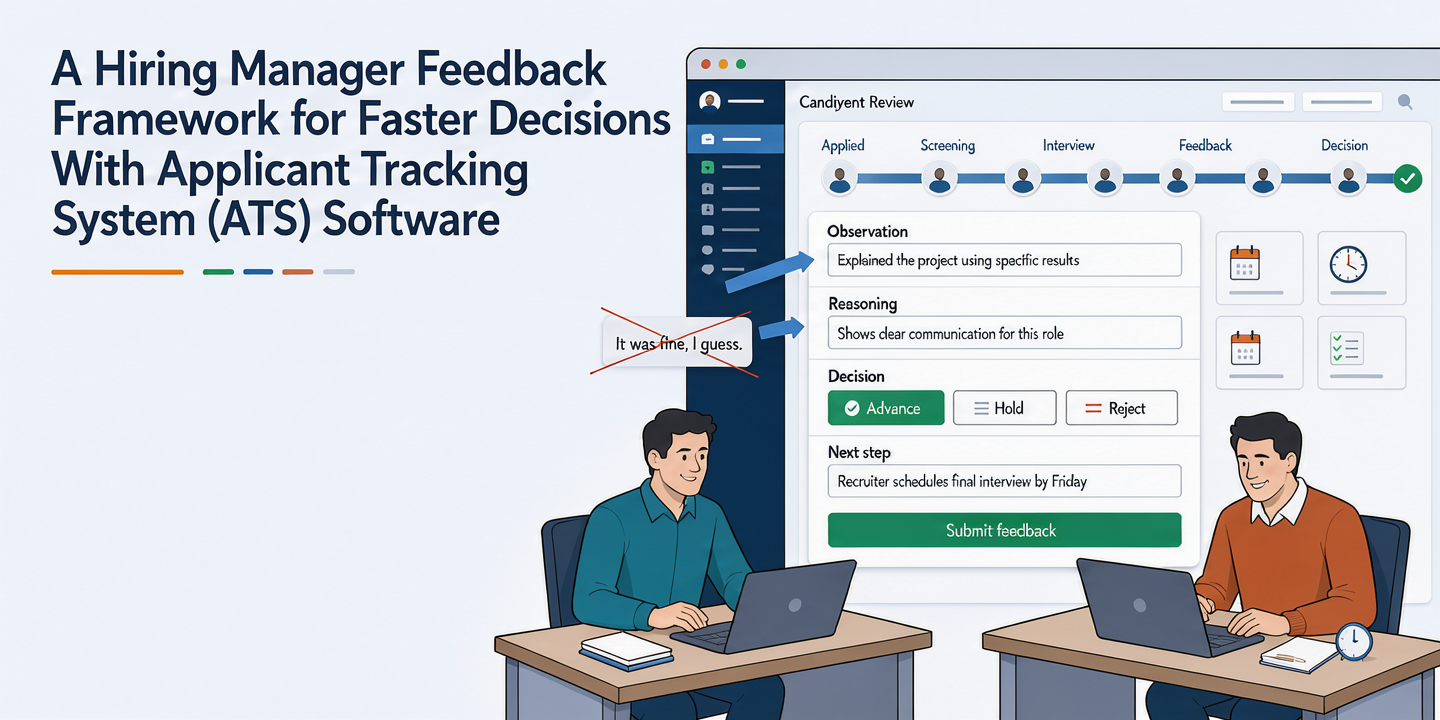
A hiring manager feedback framework fixes vague interview comments by requiring four specific things: an observation, the reasoning behind it, a clear decision, and a next step. Most applicant tracking system (ATS) software tracks where a candidate sits in the pipeline, but it doesn’t structure what the hiring manager actually says about them. That gap is why strong candidates stall even when the process looks busy. Pairing a structured feedback framework with the right ATS closes it and turns feedback into a faster decision, not a guessing game.
“It was fine, I guess.” That’s the entire piece of feedback three hiring managers gave a recruiter last month, about three completely different candidates for three completely different roles. Vague feedback like this isn’t a personality quirk. It’s a process gap, and your applicant tracking system (ATS) can’t close it by itself, no matter how clean the pipeline looks on screen.
Recruiters end up chasing hiring managers for details that never arrive, then either restart the loop or make a call on incomplete information. A hiring manager feedback framework fixes this by giving every interviewer the same four fields to fill in, every time. Here’s what that structure looks like, why feedback stays vague without it, and how the right ATS should be picking up the slack.
Fine, I Guess: Feedback That Says Nothing
Hiring managers give vague feedback because nothing in the process asks them for more. Most interview scorecards have one open text box and a rating scale, so “good vibe” technically counts as a complete answer. Recruiters are left interpreting tone, chasing hiring managers for specifics days later, or moving a candidate forward on a hunch. None of this shows up as a formal delay. It just quietly adds days to every decision, one unclear comment at a time.
Structure Beats Willpower, Every Time
Hiring managers aren’t withholding detail on purpose. They’re busy, the form doesn’t require it, and there’s no consequence for skipping it. The best AI mock interview tools succeed for the same reason a good feedback framework does: they force three things every time: a specific observation, the reasoning behind it, and a next step. A resume parser can extract skills and experience in seconds, but that same discipline disappears the moment a human has to render a judgment call. Structure has to pick up where automation stops.
A Four-Field Framework That Forces Clarity
A hiring manager feedback framework works best when it’s short enough to actually get filled out. Four fields cover it:
- Observation: what specifically happened in the interview, not a general impression
- Reasoning: why that observation matters for this particular role
- Decision: advance, hold, or reject, stated plainly
- Next step: who does what, and by when
This isn’t a compliance exercise. Each field removes a specific kind of ambiguity that’s currently stalling a decision somewhere in the pipeline.
The Payoff: Decisions That Don’t Stall
When feedback follows a fixed structure, a few things change immediately:
- Recruiters stop translating vague comments into a decision on someone else’s behalf
- Hiring managers spend less time being chased for details they never wrote down
- Candidates get a clear answer sooner, instead of disappearing into a queue
None of this requires hiring managers to write more. It requires them to write the same four things, every time, in the same place. Pair this with a leaner approval workflow and the entire path from interview to offer gets shorter, not just the feedback step.
The Missing Piece in Your ATS Software
Most HR applicant tracking platforms are excellent at logging where a candidate sits in the pipeline. They track when a resume arrived, when it passed ATS-friendly resume screening, and when the interview was scheduled. What most of them skip is the feedback itself. Xorofy’s interview module builds the four-field framework directly into the scorecard, so a hiring manager can’t submit a review that skips reasoning or a next step. It’s a small structural change, but it’s the difference between an applicant tracking system (ATS) software platform that tracks status and one that actually moves decisions forward. Most AI recruiting software still treats feedback as an afterthought to sourcing. That’s the gap this closes.
Fix the Form, Fix the Decision
Hiring managers don’t need a lecture on giving better feedback. They need a form that makes vague feedback structurally impossible. A hiring manager feedback framework does that in four fields, and the right applicant tracking system (ATS) software makes sure those fields are part of the workflow, not an extra step nobody has time for. Fix the structure, and decisions come faster.