
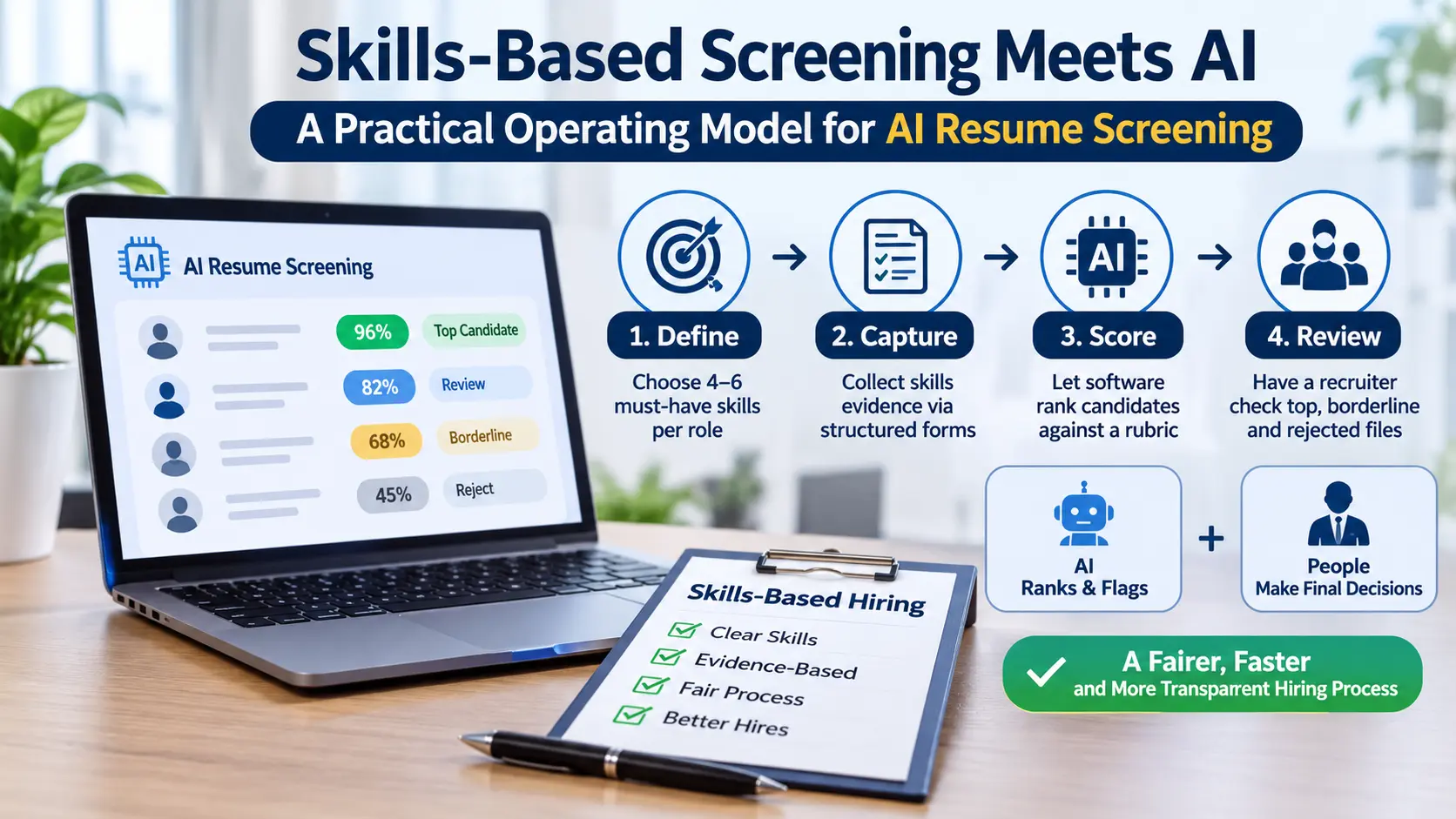
AI resume screening works best with a clear process. First, define four to six must-have skills for each role. Second, capture evidence of skills through structured forms. Third, let software score candidates against a written rubric. Fourth, have recruiters review top, borderline, and sampled rejected files. AI should rank and flag, while people make final decisions. This model cuts manual review, improves shortlist quality, and keeps skills-based hiring fair and easy to explain.
Every recruiter knows the feeling. You open a stack of applications, and every resume sounds equally qualified. Skills-based hiring promises a fix, and AI resume screening promises speed. Yet many teams still read each file by hand because they do not trust the ranking they see. That caution is fair.
The problem is rarely the tool. It is the missing process around it. Without clear skills, clear scoring, and clear human checkpoints, AI only sorts resumes faster, and often by the wrong signals. This guide gives HR leaders and recruiters a simple operating model. You will see what to define, what to automate, and what to keep in human hands, so every shortlist rests on evidence you can explain to any hiring manager.
Resume Volume Has Outgrown Manual Review
Manual review breaks down because generative tools now make every resume look polished. When each candidate submits an ATS-friendly resume with clean formatting and matched keywords, presentation no longer separates strong applicants from average ones.
Research on generative AI resume tools has also raised concerns about inflated claims and screening bias. Our piece on how AI-generated resumes are breaking traditional screening explains the cause in detail. Teams that try AI resume screening without a rubric simply automate the same confusion. The fix is to read for evidence of skills, not for polish.
A Four-Step Operating Model for AI Resume Screening
A workable model has four steps: define, capture, score, and review. Each step has one owner and one output, which keeps the process easy to audit.
- Define: Choose four to six must-have skills per role, with a plain description of what proof looks like.
- Capture: Collect skills data at application, not after the resume is read.
- Score: Let software rank candidates against your rubric and show why.
- Review: Have a recruiter check the top group, the borderline group, and a sample of rejections.
Capture Skills Data Before the Resume Is Read
Structured questions give you comparable answers from every candidate. A short form asking for a work sample link, a tool rating, or a one-line example is far more useful than a paragraph of buzzwords. Resume parsing software can then pull dates and job titles, while the form carries the skills evidence. This split keeps AI resume screening grounded in facts rather than phrasing.
The Honest Limits of Automated Screening
AI is reliable at sorting and unreliable at judging. It matches structured evidence to a rubric quickly. It cannot weigh context, such as a career break, a career change, or a project delivered under tight limits.
Where AI Resume Screening Should Stop
Use resume screening software to rank and flag, never to reject alone. A person should review every borderline file and every final rejection.
Best left to software:
- Organizing profile data
- Matching answers to the rubric
- Flagging missing information
Best left to people:
- Judging context and potential
- Checking claims that look inflated
- Making the final decision and giving feedback
Setting Up Your Tools for Skills-Based Hiring
Your applicant tracking system software must support custom fields, forms, and scorecards, or this model cannot run. If skills data lives in email threads, no ranking can use it.
A modern talent acquisition platform keeps that data in one candidate record, so recruiters and hiring managers see the same evidence. Xorofy, for example, lets teams build custom fields and forms that capture skills data at application and carry it through to review. That removes the guesswork about what a score means.
Then track two numbers each month: how often hiring managers accept your shortlist, and how long review takes per role. If managers keep rejecting top-ranked candidates, fix the rubric, not the recruiter. Check that your resume parsing software reads dates and titles correctly, and that your resume screening software shows the reason behind each rank. Your talent acquisition platform should report both numbers without manual work.
Build the Process First, Then Let Software Speed It Up
Skills-based hiring works when the process is clear before you switch on the software. Define the skills, capture the evidence, and keep people in charge of judgment. Do this, and AI resume screening becomes a dependable first pass instead of a black box. Your shortlists move faster and are easier to defend.
FAQs
Does AI resume screening remove bias?
Not by itself. It can repeat patterns from past data, so audit rankings regularly and keep a person in the final decision.
How many skills should a role scorecard include?
Four to six. More than that weakens the ranking and slows review.
Is an ATS-friendly resume enough to get shortlisted?
No. Formatting helps a parser read the file, but shortlists depend on visible evidence of skills.